
CMMS failure codes that technicians can apply consistently
Just a 17-minute read
CMMS failure codes are controlled labels used to classify equipment failure information. To make them useful, define what each field means, give technicians clear selection rules and test the dictionary against actual maintenance records.
This guide explains how to build a manageable system that preserves uncertainty and supports reliable analysis.
Introduction
A technician selects “bearing”, another selects “noise” and a third selects “lubrication”. All three may describe the same intervention, but they answer different questions. Combining them in one failure list makes the resulting report difficult to interpret.
The practical task is to design a vocabulary that fits the equipment and the decisions the maintenance team needs to make. This article focuses on that dictionary and its use during failure reporting, rather than the subsequent investigation of recurring problems.
What CMMS failure codes should describe
A useful coding system separates the failed function, observed condition, affected component, cause and action taken. These relationships matter more than whether the identifier contains letters, numbers or both.
Software terminology varies. For example, IBM documents failure hierarchies organised around failure classes, problems, causes and remedies. That is one implementation pattern, rather than a universal naming convention. IBM failure hierarchy documentation.
For an industrial maintenance dictionary, distinguish the following concepts.
- Symptom
An observed indication, such as abnormal noise or a temperature alarm. - Failure mode
How an item fails to perform its required function, such as a valve failing to close. - Failed component
The item affected, such as an actuator, seal or bearing. - Failure mechanism
The process producing the failure, such as corrosion or fatigue. - Failure cause
The circumstances responsible for the failure, supported by investigation. - Maintenance action
What the team did, such as replacing an actuator or adjusting a linkage.
ISO 14224 provides a reference for structuring equipment, failure and maintenance data. Its formal scope covers petroleum, petrochemical and natural gas operations. Teams in other industries should assess its applicability rather than copy a classification unchanged. ISO 14224 scope.
A code records a classification. It does not prove a diagnosis. “Actuator replaced” describes an action, while “incorrect supply pressure” requires supporting evidence before it becomes a confirmed cause.
Keep concise technical notes alongside codes. The code supports grouping; the note preserves readings, circumstances and findings. NIST research shows that missing data, inaccurate entries and unsuitable fields can undermine maintenance indicators and trend analysis. NIST maintenance work order data study.
ManWinWin’s guidance on standardising maintenance data provides the wider context. The dictionary turns that principle into selection rules people can use.
ManWinWin Software is the result of 40+ years of experience and know-how

Get a personalized demo of ManWinWin CMMS
Please fill out the form and wait for one of our specialists to contact you to schedule a date at your convenience.
- Discover how ManWinWin solves your specific challenges.
- See ManWinWin’s core features, tailored to your needs.
- Gain best practices from the world’s most experienced CMMS company, specific for your success.
- Discover your ideal ManWinWin license, investment, and timing of implementation.
How to build usable CMMS failure codes
Use four connected steps to define the information, document the choices, test interpretation and control revisions. Start with one equipment family where maintenance records contain enough detail to support a meaningful pilot.
1. Define fields
Decide which question each field answers before creating its code list. For a valve family, the failure mode field might describe failure to open, failure to close or internal leakage. The component field might identify the actuator, positioner or seat. Keep these dimensions separate so the team can analyse each without interpreting a mixed list.
Define when information becomes available.
- At reporting, capture the asset, required function, observed symptom and operating context.
- During diagnosis, add findings, affected components and supporting measurements.
- At technical review, confirm the applicable classifications and distinguish established causes from unresolved explanations.
Do not require the person reporting a fault to know its cause. Use explicit cause states such as unknown, suspected and confirmed. A required field that forces a guess produces complete records with unreliable content.
Connect these requirements to the work order management process. Document who supplies each item and who reviews it.
2. Build dictionary
Give every code a plain language definition, an inclusion rule, an exclusion rule and an example. Record the equipment family and field to which it belongs. The following is a hypothetical local dictionary entry. Its identifier is illustrative and is not presented as an ISO code.
- Identifier: VFC
- Field and equipment family: Failure mode for actuated valves
- Label: Fails to close
- Definition: The valve does not reach its required closed position following a valid close command under the specified operating conditions.
- Select when: Inspection or testing establishes that the required closed position was not achieved.
- Do not select when: The valve reaches the closed position but exceeds its permitted internal leakage criterion. Record that under the applicable leakage mode.
- Supporting information: Command state, observed position, relevant operating conditions and test reference.
“Fails to close” does not establish whether the actuator, linkage, control signal or another condition caused the failure. Use equipment specific lists where distinctions matter. Avoid mixing symptoms, mechanisms and actions merely because all three appeared in previous repair notes. Keep “other” available for a documented condition outside the dictionary. Keep “unknown” for information that has not been established. Those are different situations and need different responses.
3. Test decisions
Ask technicians from different shifts to classify the same sample of historical records independently. Include straightforward cases, incomplete reports and cases that sit between similar codes.
For every disagreement, establish whether the problem lies in the definition, available evidence or training. A useful test is whether two competent reviewers choose the same classification for the same reason. Agreement on a vague code is not enough. For example, one reviewer may select “fails to close” because the operator reported that the valve was open. Another may select “position indication fault” because the record contains conflicting feedback. If no independent position check was recorded, the evidence may be insufficient to establish either diagnosis.
Use the pilot to improve the reporting requirements as well as the dictionary. Record the missing observation instead of settling the disagreement by preference. Track a small set of measures.
- Records requiring recoding as a share of reviewed applicable records
- Use of “other”, with the accompanying explanations
- Unresolved causes, separated by investigation status
- Missing evidence needed to support the selected classification
Set local acceptance criteria before expanding the pilot. There is no universal number of codes or acceptable error rate for every equipment population.
4. Govern changes
Assign a technical owner to the dictionary and define how users request additions or corrections.
Each approved change should record its reason, effective date and treatment of historical records. Retain a revision history so reports remain interpretable after terminology changes. Apply these rules.
- Keep identifiers stable while their meanings remain unchanged.
- Create a new identifier when the technical meaning changes materially.
- Retire obsolete choices from future use while preserving their historical meaning.
- Map old codes to new categories only where the original evidence supports the mapping.
Review “other” entries and recurrent selection errors. Add a code when a distinct condition needs a distinct maintenance decision, rather than whenever someone uses a new phrase.
ManWinWin’s CMMS implementation guide includes development of a failure modes tree. Use that implementation work to agree definitions and responsibilities alongside software configuration.

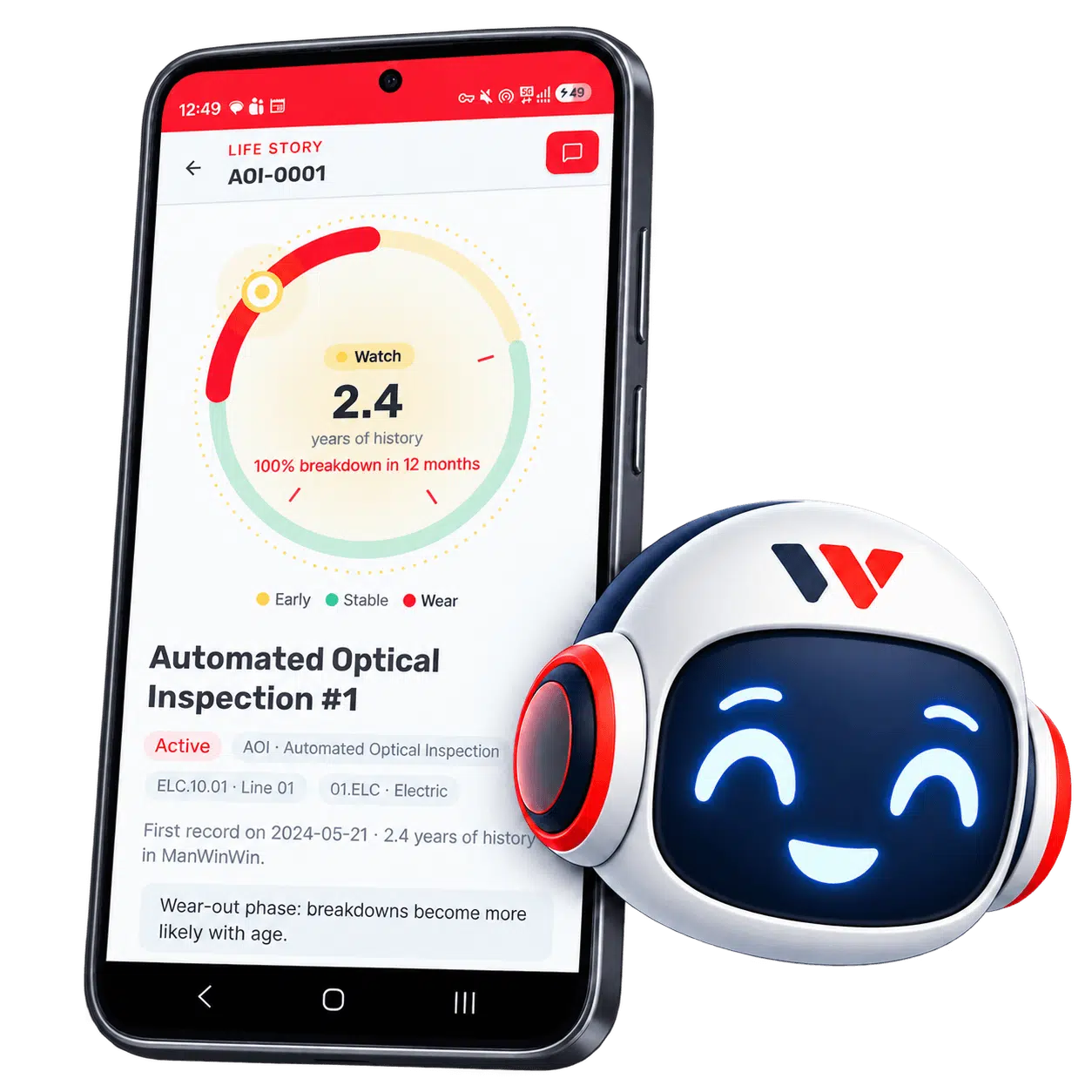
Meet Winston.
The AI that knows your maintenance.
Winston knows your ManWinWin. Ask in plain words and get exact answers from your own data, at your desk, on the shop floor or hands-free. In the Winston Help Center, learn ManWinWin with guides and videos and get support from our team.

Frequently asked questions
How many failure codes should an equipment family have?
dummy
How many failure codes should an equipment family have?
Use enough codes to distinguish conditions that lead to different technical decisions. Begin with relevant modes supported by equipment knowledge and maintenance history, then test coverage. A short ambiguous list can be as unhelpful as a long overlapping one.
Should every work order require a failure code?
No. Routine preventive work does not automatically represent a failure event. Define coding requirements by work type and record actual findings without converting every inspection into a failure.
Can a work order close while the cause remains unknown?
Restoration and causal investigation can have separate completion criteria. Where local procedures allow operational closure, retain the cause as unresolved and link any required investigation to a responsible person. Closure must not silently convert “suspected” into “confirmed”.
Is a PLC alarm code the same as a maintenance failure code?
No. A programmable logic controller alarm identifies a condition recognised by the control system. Preserve the alarm reference, but classify the maintenance finding separately because an alarm alone may not establish the failed function or cause.
Should old free text records be converted into codes?
Convert records only where the available evidence supports the classification. Preserve the original text and distinguish retrospective coding from information recorded during the intervention. Do not backfill a probable cause merely to remove blanks.
Can Winston AI help with failure coding?
ManWinWin describes Winston AI as providing access to equipment history and diagnostic assistance using past repairs and manuals. That can support a reviewer looking for context, but the evidence still determines the classification. Treat any suggested cause as provisional until technically checked. Winston AI capabilities.
Conclusion
Make the dictionary part of maintenance work
Begin with one equipment family, define the fields and write selection rules around actual maintenance decisions. Test the dictionary with technicians, preserve unknown causes and assign ownership before extending it across sites.
ManWinWin’s verified asset, work order and reporting capabilities provide the records and operational context needed to apply this discipline. A useful dictionary connects those records through consistent meanings, while technical review keeps classifications tied to evidence.
ManWinWin is a globally proven CMMS platform positioned between lightweight SaaS tools and heavy enterprise EAM suites, offering structured, scalable, and practical maintenance management for industrial and multi-site organizations worldwide.
Ready to take your maintenance to the next level?
Trusted in over 120 countries – join the global maintenance movement with ManWinWin Software
















About the Author
José Fernandes is the Managing Partner at ManWinWin Software (Navaltik Management), leading company in maintenance management consultancy and CMMS (Computerized Maintenance Management System) solutions.
With a technical background in industrial organization, José Fernandes has been with Navaltik since the 1990s, progressing from consultant to strategic leader and a key figure in the development of the ManWinWin software.
Throughout his career, he has overseen hundreds of maintenance system implementations across more than 30 countries, including regions in Africa, Australia, the Middle East, and East Asia.