Technical Documentation
Digitalization in Industry: Mobility and Maintenance Management at CIN
A Project to Implement Mobility and Process Digitalization Solutions in Maintenance Management
The RA 2D maintenance feature has become a practical solution for technicians to carry out tasks with ease.
sing a visual interface, they now interact with images of equipment or diagrams of components, identifying specific areas through visual access points that represent maintenance tasks.

1. INTRODUCTION
Industrial maintenance, often underestimated in its importance, is a complex web of activities in which lies the essence of the details that support the smooth running of industrial operations. From the regular inspection of equipment to the careful lubrication of machinery, these seemingly trivial procedures are the practical expression of preventive maintenance plans, a strategy which, according to Mobley [1], is an “absolute requirement for the reliability of assets”, thus forming the backbone of the efficiency and stability of the production process.
In recent years, there have been significant transformations in this area, catalyzed by successive technological advances, which have redefined various practices. These developments have replaced manual processes with more automated and digital systems, improving not only efficiency but also unplanned downtime, which in turn contributes to increasing the reliability of industrial equipment.
These changes give an advantage to organizations, whose viability depends directly on their ability to remain competitive, either by increasing productivity or by optimizing operational resources. In particular, mobility solutions represent a significant innovation for maintenance management, bringing about a considerable transformation in the response capacity of maintenance teams (whose increasingly complex activity in a factory environment requires the adoption of best practices and methodological strategies), with a significant impact on operational efficiency.
The use of new technologies naturally presents challenges – cultural and organizational change being the main ones – and therefore requires a holistic approach that includes training employees, reviewing internal processes and efficiently integrating technology into the existing workflow. The successful implementation of a project to digitize maintenance processes therefore requires a comprehensive vision that takes all these aspects into account.
It is in this context that this article sets out to present an example of a project that has successfully made the transition to the full digitalization of maintenance in a company that has been familiar with the use of a computerized maintenance management system (CMMS) for several years. It details the objectives set, the solutions adopted and the benefits achieved, with the aim of providing an overview of best practice in the effective integration of technology in this sector.
ManWinWin Software is the result of 40+ years of experience and know-how
We have helped companies around the world to improve their maintenance

Recognized

Microsoft Partner
Customers
Countries
Languages
Partners
2. IMPLEMENTATION PROCESS
The “Mobility and digitalization of maintenance processes” project took place at CIN – Corporação Industrial do Norte, S.A., a Portuguese company based in Maia, whose main activity is the manufacture and sale of paints and varnishes. It currently operates ten plants in six countries. Since 1992, it has led the domestic market and, since 1995, it has become the leader in the Iberian Peninsula. It was recently recognized as the tenth largest paint manufacturer in Europe [2].
After many years of significant progress in maintenance management, leveraged by the “ManWinWin” CMMS, the project came about naturally. With a view to continuous evolution in practice, the opportunity was identified to optimize certain procedures by adopting mobility software, especially for preventive interventions. In particular, the replacement of traditional paper work orders with mobile devices such as tablets stood out as a favorable strategy for improving the effectiveness and efficiency of maintenance operations.
This fundamental pillar established the simplification of technicians’ activities on the shop floor as the project’s main objective, with a natural positive effect on the service provided by the maintenance function. With this change in model designed to improve the productivity of the maintenance team, the following goals were also set:
- Improve the effectiveness of the preventive maintenance system;
- Reduce the incidence of corrective interventions;
- Raise the level of precision and accuracy of interventions;
- Increase the operational efficiency of the maintenance team;
- Improve the quality of intervention reports.
In the process of defining objectives and guidelines, it was identified that the project’s potential for improvement could be maximized by developing a new feature. Thus, a new feature, called 2D Augmented Reality (2D AR), was integrated into the existing mobility solution, with the aim of guiding maintenance technicians more objectively during interventions, providing them with contextual information, real-time data and collaboration tools. The implementation of this resource was intended to align the project with its central objective: to reach a more advanced level in the execution of maintenance interventions, ensuring the best possible operational efficiency.
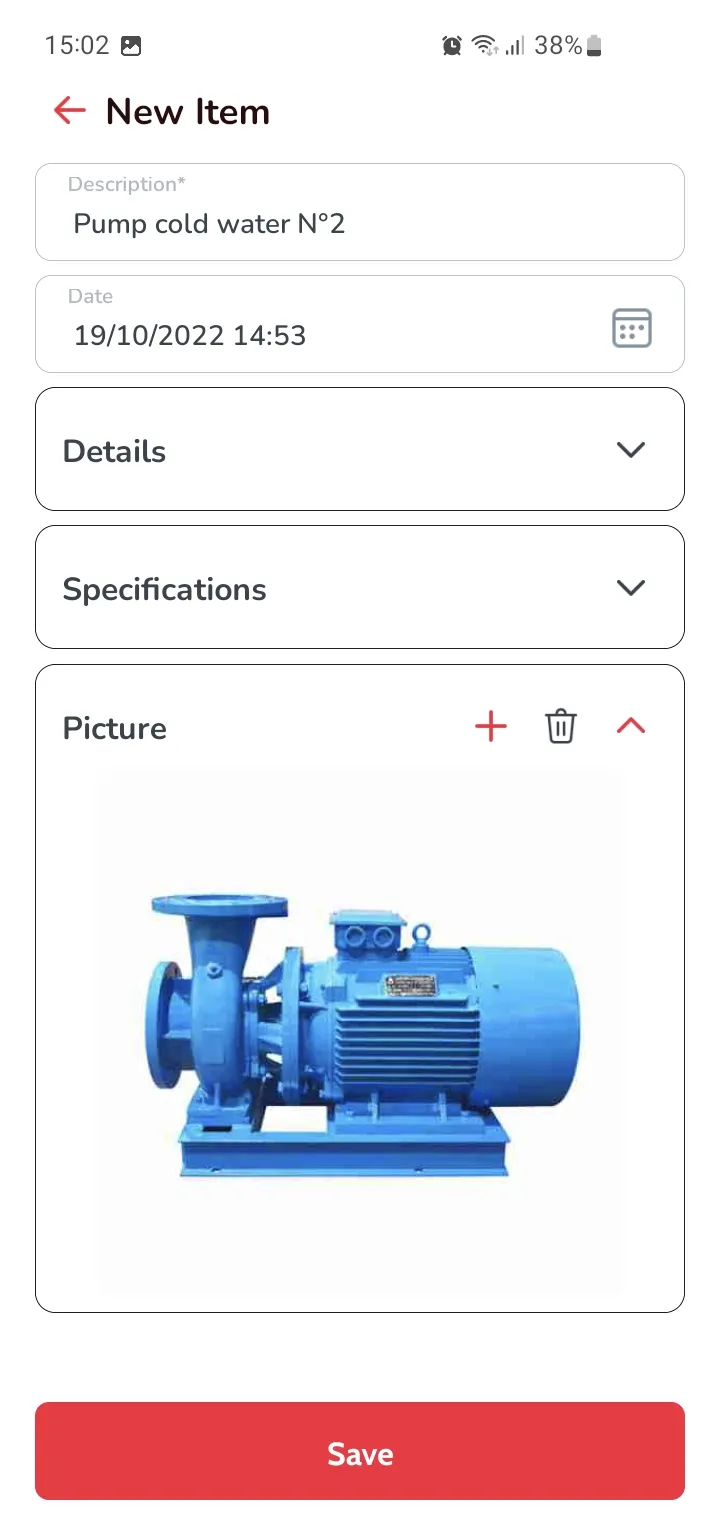
The project consisted of two main components: IT developments and implementation sessions (consultancy and training). As part of the former, some of the resources already in the mobility application were adjusted and the new resource was incorporated; during the initial implementation phase, it was necessary to gather an extensive set of information to carry out the necessary loading onto the assets, including photographs (of the equipment and its components), manuals, technical drawings and intervention points, among other relevant elements. This stage was essential to optimize the use of mobility.
In order to fully benefit from the new 2D RA resource, it was also necessary to adapt the library of maintenance tasks (in addition to updating those that were lacking) that had been used as the basis for the various maintenance plans, making it better prepared for the mobility platform. To do this, its content was redefined, converting and unfolding the various sets of existing activities – registered on the basis of periodicity (e.g. “Annual Review”) – into individual tasks, thus making it possible to individually flag each maintenance task with the labels Done OK, Done NOK or Not Done.
In addition, this solution introduced the possibility of individualized observations, making it easier, among other advantages, to justify why a task was not carried out or, if it was, to indicate any problems identified (e.g. the compressor inlet pressure was measured, but it was found that it was not within normal parameters). The project also offered an opportunity to improve equipment registration, aligning physical existence with computerized registration, both in terms of inventory and in terms of enriching existing data.
As mentioned at the beginning, the training of technicians was a fundamental premise for the success of this project, so it was necessary to train the maintenance team in the new resources, namely to carry out interventions in a more targeted manner. After six months of using the new system, a survey was carried out among nine technicians from the maintenance team, from which the main results for this article were drawn. These reveal that:
89% considered the tablet to be a more practical tool compared to the paper work order
100% said that the tablet allowed them to access information in a more agile and practical way
78% felt that the tablet had become a very important support in the management of interventions, highlighting the time savings
100% answered that the use of the RA 2D resource significantly facilitated the execution of preventive maintenance work
The general satisfaction of the maintenance technicians and the reduced resistance to change with the replacement of physical work orders with a mobile solution were the first successes of the implementation. In line with the central objective of the project, the technicians evaluated the tablet as a useful tool, as it allowed them almost instant access to crucial data, in contrast to paper, which limited their consultation of the information available there.
As well as promoting an environmentally responsible attitude, the change has brought other advantages, especially for managers and other non-operational members of the department, such as considerably simplifying the process of launching, allocating, recording and closing work. Previously, once the work had been completed, the technicians would hand in paper work orders to the workshop manager, who would then enter the information into the system. Now, the reports are made directly by the technicians, eliminating this intermediate step.
3. BENEFITS ACHIEVED
The results of this team consultation confirmed the success of the implementation, which brought effective gains to the department. The mobility solution has significantly changed the paradigm, introducing several changes to procedures and improving overall maintenance performance. The main benefits obtained are summarized below.
Simplified maintenance with interface
The RA 2D maintenance feature has become a practical solution for technicians to carry out tasks with ease. Using a visual interface, they now interact with images of equipment or diagrams of components, identifying specific areas through visual access points that represent maintenance tasks. This approach makes it possible to have targeted and sequential instructions, illustrating and facilitating the various steps in carrying out tasks.
Efficient task management
With the visual interface, technicians can navigate efficiently through each maintenance task, marking it as completed once it has been carried out. This intuitive process has simplified job management, ensuring that no step is missed and facilitating a smooth operational flow.
Quick access to additional information
Interventionists now have access to additional information associated with each task, including text descriptions, manuals, images or instructional videos. This content has improved technicians’ understanding and proficiency, ensuring tasks are carried out more accurately.
Significant improvement in maintenance efficiency
The RA 2D feature, with access facilitated by near field communication tags, commonly known as NFC, or QR code, allows quick access to the list of scheduled jobs, maintenance history and other relevant information about equipment or systems. Combining visual guidance and comprehensive task management functionalities, the feature has significantly improved efficiency and workflows. For example, in the work report, it is possible to record in real time the labor committed, associate photographs, videos or documents, and obtain the digital signature of the technician responsible for carrying out the intervention, as well as the requester, to validate work resulting from breakdowns.
The value added by this project has been the ability to carry out activities with greater precision, substantially reducing the likelihood of errors or failures – an approach that contributes to improving the reliability and performance of assets. In fact, the positive impact of the project has been reflected in various indicators, including a significant reduction in the unavailability of equipment, as well as a reduction in the costs associated with corrective maintenance, despite the inflation that is still being felt, especially in relation to materials.
The effects of the project have led to a number of changes in the organization’s maintenance management, mainly due to the improvement of various aspects discussed above. To describe the current situation, about a year after the project was implemented, some key results and indicators are presented.
Equipment park
Enriched equipment park register (technical characteristics, components, photographs, manuals, etc.).
Preventive maintenance plans and work orders
- Maintenance task library restructured and prepared for RA 2D functionality (407 preventive tasks);
- Maintenance plans revised and updated;
- Maintenance plans adjusted and prepared for RA 2D functionality;
- Fully digital work orders, streamlined by RA 2D functionality;
- Significant reduction in wasted time (by previewing the work, which makes it possible to anticipate travel and resource requirements for the execution of work orders);
- Significant improvement in the quality of maintenance reports.
Maintenance parameters and indicators
- A 3.0% increase in compliance with preventive maintenance work (compared to planning);
- 2.6% increase in the number of preventive interventions carried out;
- 4.5% reduction in the number of corrective jobs;
- 32.7% reduction in corrective maintenance costs;
- An 18.1% increase in MTBF (for equipment in which RA 2D has been fully implemented);
- MTTR contraction of 17.2%;
- Decrease in the incidence of maintenance requests by 6.6%.
Join ManWinWin Software, the world’s most experienced company in CMMS!
Choose a better way to manage your Maintenance
Watch or book a Demo
Watch a recorded demo or get to know ManWinWin guided by one of our experts.
Use ManWinWin free version
Free forever industrial maintenance management software up to 100 Assets. Start today!
4. FINAL CONSIDERATIONS
The results of implementing the “Mobility and digitalization of maintenance processes” project are clear and promising. The transition to digital work orders, boosted by the RA 2D functionality, has generated a significant improvement in the efficiency of operations. This change has not only optimized the execution of maintenance tasks, but has also played a crucial role in achieving the expected benefits. In addition, the adoption of new technologies has simplified daily processes, increased the accuracy of interventions and improved the quality of the reports produced.
This project didn’t just transform the way maintenance is conducted; it set a new standard of excellence and adaptability to modern industrial requirements. The successful implementation not only demonstrated the effectiveness of mobility and digitalization solutions, but also strengthened the company’s position in asset management. With substantially improved performance indicators, the positive impact of this initiative for the industrial sector is evident.
BIBLIOGRAPHICAL REFERENCES
[1] Mobley, R. K. (Ed.). (2009). Maintenance Engineering Handbook (7th ed.). New York, NY: McGraw-Hill
[2] European Coatings (2023). Ranking 2023: Europe’s Top 25. Accessed on June 4, 2024 at https://www.european-coatings.com/news/markets-companies/ranking-2023-europes-top-25/
Discover ManWinWin services in maintenance management consulting

Training
Training is the component that consolidates and sustains the solution on the client.

Want to know how the world’s most experienced CMMS maintenance management software can help you?
Join ManWinWin Software, the world’s most experienced company in CMMS!
Choose a better way to manage your Maintenance